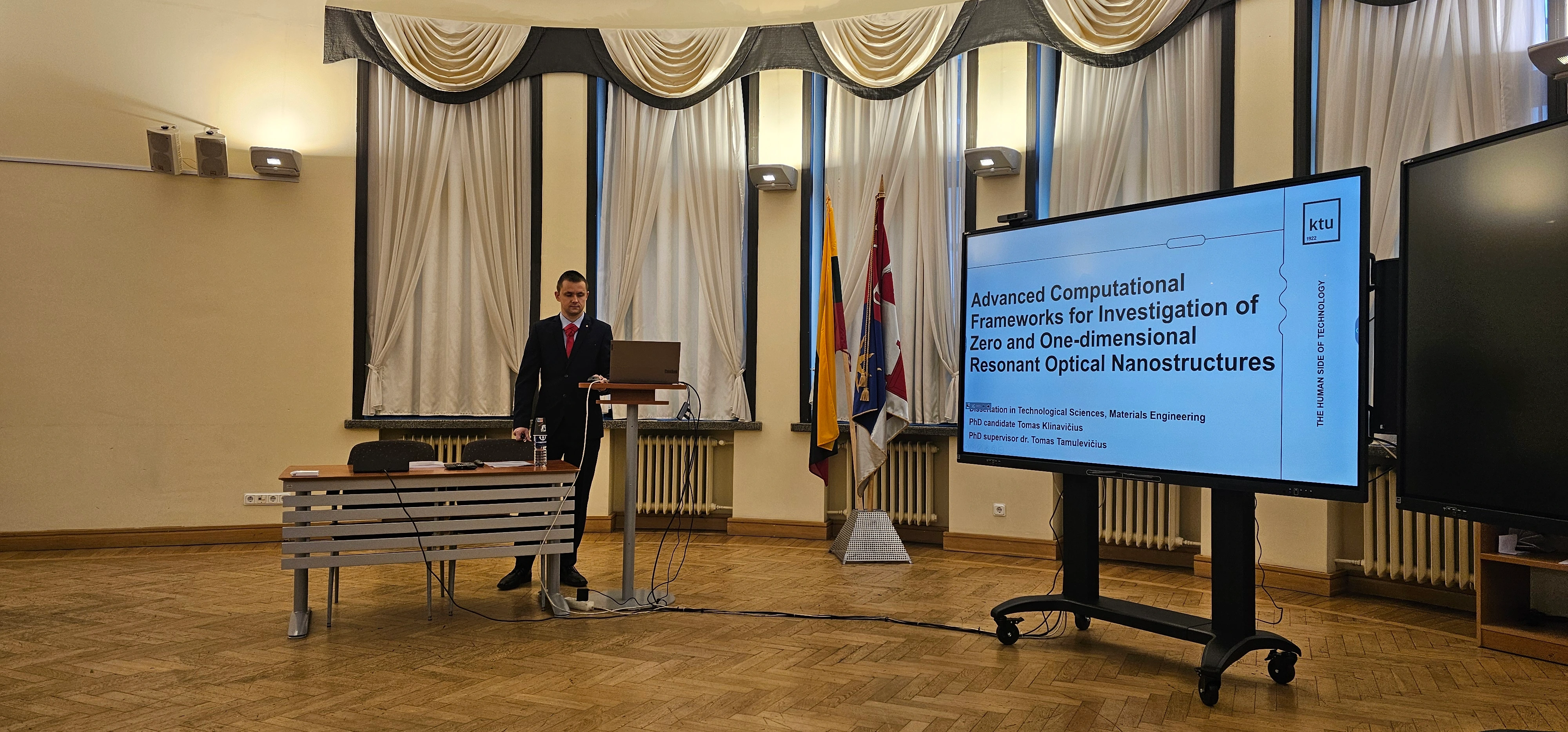
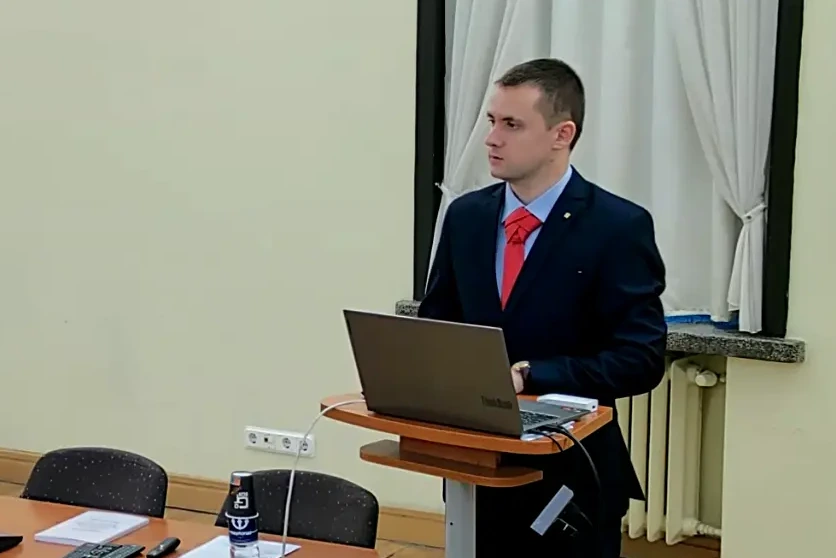
On November 27, 2025, Tomas Klinavičius, a doctoral student at the Institute of Materials Science, defended his doctoral dissertation “Advanced computational models for the study of point and one-dimensional optical resonant nanostructures” in the field of materials engineering and became another employee of the institute with a doctoral degree.
The dissertation examines numerical and optimization methods that can design selectively reflective coatings that increase the efficiency of combined energy systems consisting of photovoltaic solar cells and thermal solar cells. According to theoretical estimates, the efficiency of systems using these coatings could reach 50%. These coatings would also reduce the thermal damage experienced by photovoltaic cells. The dissertation also examined neural networks designed to describe the size distribution of colloidal silver and gold nanoparticles. These nanoparticles, acting as additives in photovoltaic cells, can also increase their efficiency. An accuracy of 1.2% was achieved in determining the size of silver nanoparticles using neural networks. The dielectric permittivity of gold was also estimated using optimization methods.